The Importance of Fun in Your Curriculum
Apr 22, 2026I once worked with a teacher named Gerry who taught a cross-curricular Physics/Algebra II class. One year in November, when the luster of the new school year was quickly wearing off and student engagement was declining, Gerry had an idea to spice things up.
And so came about the Great Pumpkin Drop project.
Gerry took a set of physics content standards dealing with terminal velocity and the speed at which objects fall, and created a competition. Using algebraic formulas and properties found in physics, students would have to become masters at predicting how long it would take for an object to hit the ground when dropped from certain heights, and see who in the class could make the best prediction for how long it would take a 20-pound pumpkin to fall from 60 feet above ground.
For a week his students filled the hallways, standing on ladders and dropping things like golf balls and apples, and timing the descent of the objects to the ground.
They took their data and plugged it into the formulas they were learning, and spent time discovering how the experience of terminal velocity related to theories and mathematics.
Gerry called the city utilities department and asked if they would be willing to send a bucket truck to our school for a morning to help with a class project. He also called a local pumpkin patch to see if they could donate a couple of hundred pumpkins leftover from Halloween.
When Pumpkins fall, students engage.
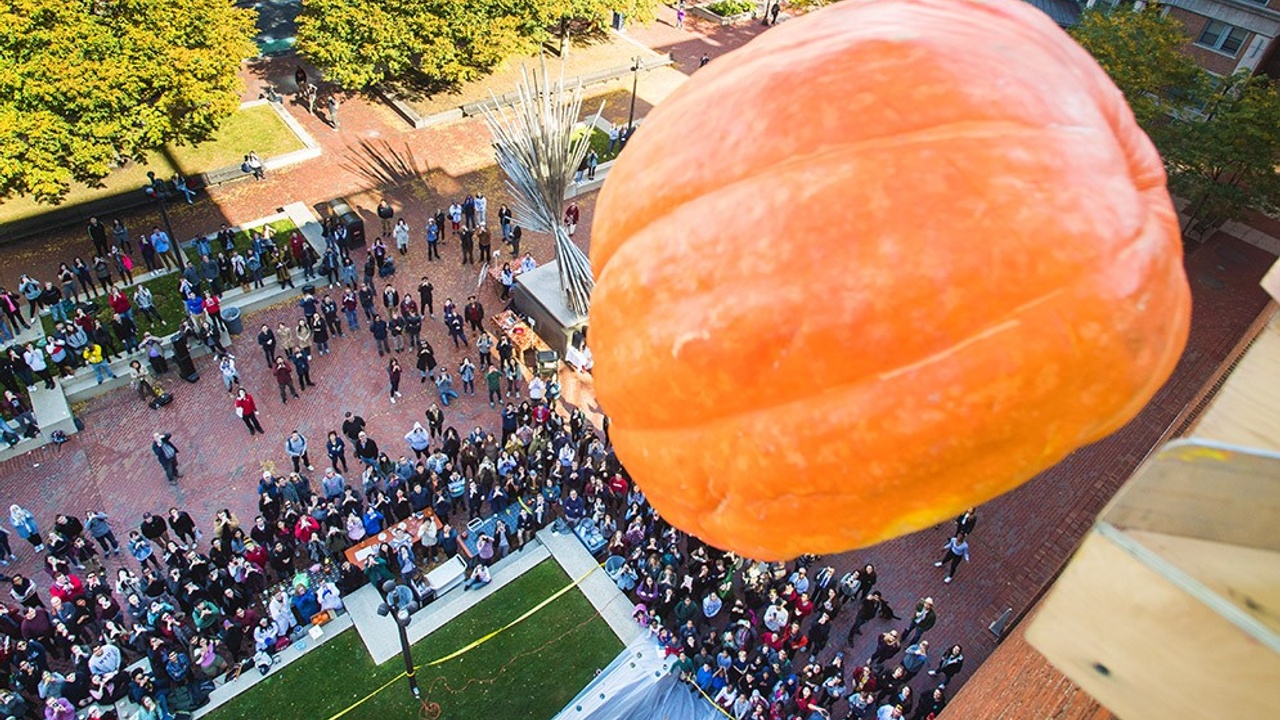
And then on a cold November morning, a 60-foot bucket truck pulled into the parking lot of our school. Buses full of area elementary students followed closely behind to watch the action. A news van parked next to a tarp where the rotting pumpkins would smash hard onto the ground. Four hundred high school students poured out the front door of our school to watch Gerry, the epic science teacher, smash pumpkins against the asphalt from sixty feet up.
But the physics/algebra II class was not laughing as their teacher dropped the pumpkins from the sky. They weren’t entertaining the little kids who shrieked and screamed as gourds exploded on tarps stretched across the pavement. They weren’t even lining up to get on the evening news and gain a little local fame.
They lined the tarp with stopwatches in their hands to see if their predictions were correct. Who in the class guessed the closest and gets to revel as the master of terminal velocity and take home a pumpkin-shaped trophy and eternal bragging rights.
Engaging in math and science was essential.
Students would not have a chance whatsoever of having the most accurate prediction if they did not master the content first. Therefore, math class had a purpose for that month. There was finally clarity as to how algebra can be applied to something other than a quiz. Physics made sense in a way that it never had before for those students. If you ask any student who has taken Gerry’s class what terminal velocity means, they will be able to tell you in a way that is not theoretical, but instead in a way that was lived and breathed. The equation, V = sqrt ( (2 * W) / (Cd * r * A), is not just a set of numbers and variables anymore. They are the key to predicting the rate at which pumpkins fall to the ground, and ultimately, eternal glory.
But let’s be honest, the students knew that winning this competition was not life and death, or even a huge deal whether they won or lost. But they worked hard and with enthusiasm because it meant more than a worksheet that would end up in a garbage can after being graded. Students like to solve problems and overcome challenges (like all humans), and this is one they could embrace in the classroom. The challenge was motivating, and the work was fun.
This project sounds fun, right?
It was designed to be. Gerry knew that having an epic outcome to this project, tying in a thrilling climax to the story and a competition to motivate his class, would create high levels of engagement. From an outside perspective, this project really might look a little frivolous. In fact, when we got a new principal the following year, the first thing she did was cancel the Great Pumpkin drop. She said it was not “rigorous” enough.
And again, from the outside I understand. Students laughed as they smashed eggs in the hallway. Half a class period was given to a trophy ceremony rather than pure content work. A whole morning was sacrificed so pumpkins could explode on school property.
But this project was not just created for kids to have fun. Gerry wanted them to be entertained and enjoy themselves, but he also wanted them to learn in a lasting and impactful way. And that's what happened in the end. They still learned the formulas and were assessed on that learning with a summative test at the end of the unit. Those same students used that knowledge on the state test the following spring. And there was plenty of rigor involved.
But the intentional fun moments helped ensure that learning was not lost.
Fun and Deeper Learning
There is strong support in research for this connection. Studies in neuroscience show that positive emotion increases the likelihood that information will be encoded and stored in long-term memory. When students experience enjoyment, curiosity, or even anticipation, the brain releases dopamine, which plays a direct role in attention and retention. That chemical response helps signal that what is happening matters and is worth remembering.
In classrooms like Gerry’s, the excitement of the competition and the public nature of the outcome strengthened how deeply students processed the content, making the learning last.
Research in educational psychology adds another layer. Scholars like Suzanne Hidi and K. Ann Renninger have shown that interest is a key driver of deeper learning. Moments that feel fun can spark that initial interest and serve as fuel for the work that follows. When students are engaged, they are more likely to ask questions, make connections, and persist through difficulty. Those behaviors are the foundation of deeper learning. In that sense, fun is not the goal, but it often becomes a powerful catalyst that draws students into the kind of thinking that leads to real understanding.
Not everything needs to be fun.
None of this is to say that something has to be fun to be engaging. Engagement is sometimes quiet, challenging, frustrating, and even boring. Large portions of the pumpkin drop unit were not fun. There was lecture, practice, and assessment that most students would not classify as entertaining. So by no means should the call to action be that you need to eliminate anything in your curriculum that isn't fun.
But I do think we need to analyze what we teach and ask if any of it is fun. Are there moments of Joy embedded in your unit plans? But I do think we need to analyze what we teach and ask if any of it is fun. Are there moments of joy embedded in your unit plans? Are there places where curiosity is sparked, where students feel the tension of a challenge, or the satisfaction of figuring something out that actually matters? Those moments do not have to take over the entire experience, but they should exist. They act as anchors, giving students something to lean into when the work gets difficult.
When those moments are intentionally designed, they do more than lighten the mood. They signal that learning is alive, that it has purpose, and that it is worth the effort it demands. Over time, those experiences shape how students see learning itself. It’s not something to endure, but becomes something they participate in. Like dropping pumpkins from 60 feet in the sky.
Stay Connected With Trevor's Work
Join thousands of educators who receive weekly articles, videos, and inspiration from Trevor.
SPAM is the worst. I promise to only send you my best stuff and NEVER to share your email.
Author