How to Strategically Create Student Groups
Aug 21, 2026I’m a strong believer in what I like to call strategic group formation.
You know what that means?
The teacher chooses the groups. Which historically drives students crazy.
“Teacher, I promise I work so much better when I sit next to her. We’re best friends and get along great.”
Or: “Teacher, I don’t get along with him, so we really shouldn’t be in a group together.”
And of course: “Teacher, can I work with my girlfriend? We work great together.”
Yeah, I bet you do.
I've heard these lines more times than I could count. Whenever there was even a hint that students would be working or discussing in groups, there was an immediate rush to ask if they could choose who they worked with.
And most of the time, my answer was the same: NO.
Not because assigned groups were a punishment or because my mission was to separate friends so they wouldn’t talk. In fact, it was almost the opposite. Choosing groups strategically is because I want students to talk. We need them to collaborate and learn how to work successfully with different people.
When students choose their own groups, they naturally gravitate toward their friends and the people they’re most comfortable with. Sometimes that meant distraction. Other times, the collaboration came almost too easily. But students need opportunities to develop the skills to communicate and work with people outside their comfort zones.
That’s also far more reflective of life beyond school. Most of us don’t get to choose our coworkers, teammates, or collaborators. We have to learn how to work with people who have different personalities, backgrounds, strengths, interests, and ways of thinking. School is a great place to practice that.
Strategically choosing groups also allowed me to use what I knew about the dynamics in the room. I could separate students who distracted each other, pair a strong leader with someone who needed support, or occasionally put a few habitual coattail-riders together and see what happened when there were suddenly no coattails to ride.
The point is, teachers have a unique perspective on the people and social dynamics in their classrooms. And with a little intentionality, they can use that perspective to create groups that lead to better discussions, stronger collaboration, and more productive work.
So here are a few of my favorite strategies for creating effective student groups.
Start With the Right Group Size
Let’s start with how big student groups should be.
The first group project I ever had my students work in was in groups of eight.
Eight! I’m currently laughing at my first-year-teacher-self (with lots of grace-- you learn through experience).
As you can imagine, it was absolute mayhem. Students were constantly off-task. The most outspoken students were the only ones heard while the quiet ones were easily drowned out. The “slackers” had no problem shirking responsibility and allowing the inevitable go-getters to do all the work.
So for the next collaborative project, I went in the complete opposite direction and had students work in pairs. My thinking was: the smaller, the better. There’d be fewer distractions and more focus on the task at hand.
But I quickly learned that two-person groups had their own issues. Fewer ideas and skills were brought to the table, and when students disagreed, there was no majority to help them reach a decision.
It turns out there’s research to support what I was seeing.
University of Illinois researcher Patrick Laughlin and his colleagues gave 760 students complex problems to solve, comparing students who worked individually with those who worked in groups of two, three, four, and five. They found that groups of three, four, and five all outperformed the best individuals working alone. Groups of two, however, did not. Even more interesting, groups of three performed just as well as groups of four and five.
The researchers concluded that three people were “necessary and sufficient” to outperform the best individuals on the types of complex problems they studied.
That research lines up pretty well with what I found in the classroom.
For most collaborative work, I recommend groups of three or four students.
Groups of three are small enough to remain conversational but large enough to bring varying perspectives, skills, and experiences to the work. There are enough people to divide responsibilities without creating space for someone to disappear. And with an odd number, decision-making tends to be smoother.
Four-person groups can also work really well, especially when a project or task has more to accomplish and benefits from having an extra set of hands. I’d occasionally use groups of five for larger projects, but that was usually my limit. Once groups get much bigger, students tend to break into subgroups, some voices get lost, and it becomes easier for students to sit back and let others do the work.
So while the exact number depends on the task, three or four students is usually the sweet spot.
Try the End-to-End Strategy
Once you know how many students should be in each group, the next question is who should go in them?
One of my favorite ways to create balanced groups was what I call the End-to-End Strategy. It’s especially helpful at the beginning of the school year when you don’t know your students’ personalities, strengths, or collaborative skills yet. The strategy isn’t perfect, but it can help prevent the frustration that comes when students with vastly different academic readiness levels are paired together, leaving one student feeling held back and the other struggling to keep up.
Start by ranking students using some academic metric you have access to. It could be assessment data, previous grades, GPA, or anything else that gives you a rough picture of where students are academically.
Then divide that ranked list into equal sections based on the size of the groups you want to create.
For example, if you have 30 students and want to create pairs, divide the list in half. Students 1–15 make up the first half and students 16–30 make up the second. Then pair corresponding students from each half:
1 + 16
2 + 17
3 + 18
And so on.
The same strategy works for larger groups. If you have 28 students and want groups of four, divide your ranked list into four sections of seven students. Then create each group by pulling one student from the same position in each section.
The goal isn’t to label students as “high” or “low.” It’s simply to distribute different academic strengths across the room rather than accidentally loading several high-performing students into one group while another group has several students who need more support.
Of course, this isn’t foolproof. Academic performance tells you very little about personality, leadership, work ethic, or how students will interact with each other. As you get to know your students, you’ll have much better information to use when creating groups.
But especially early in the year, the End-to-End Strategy gives you a simple way to create balanced groups using the information you actually have.
Use AI and a Student Collaboration Survey
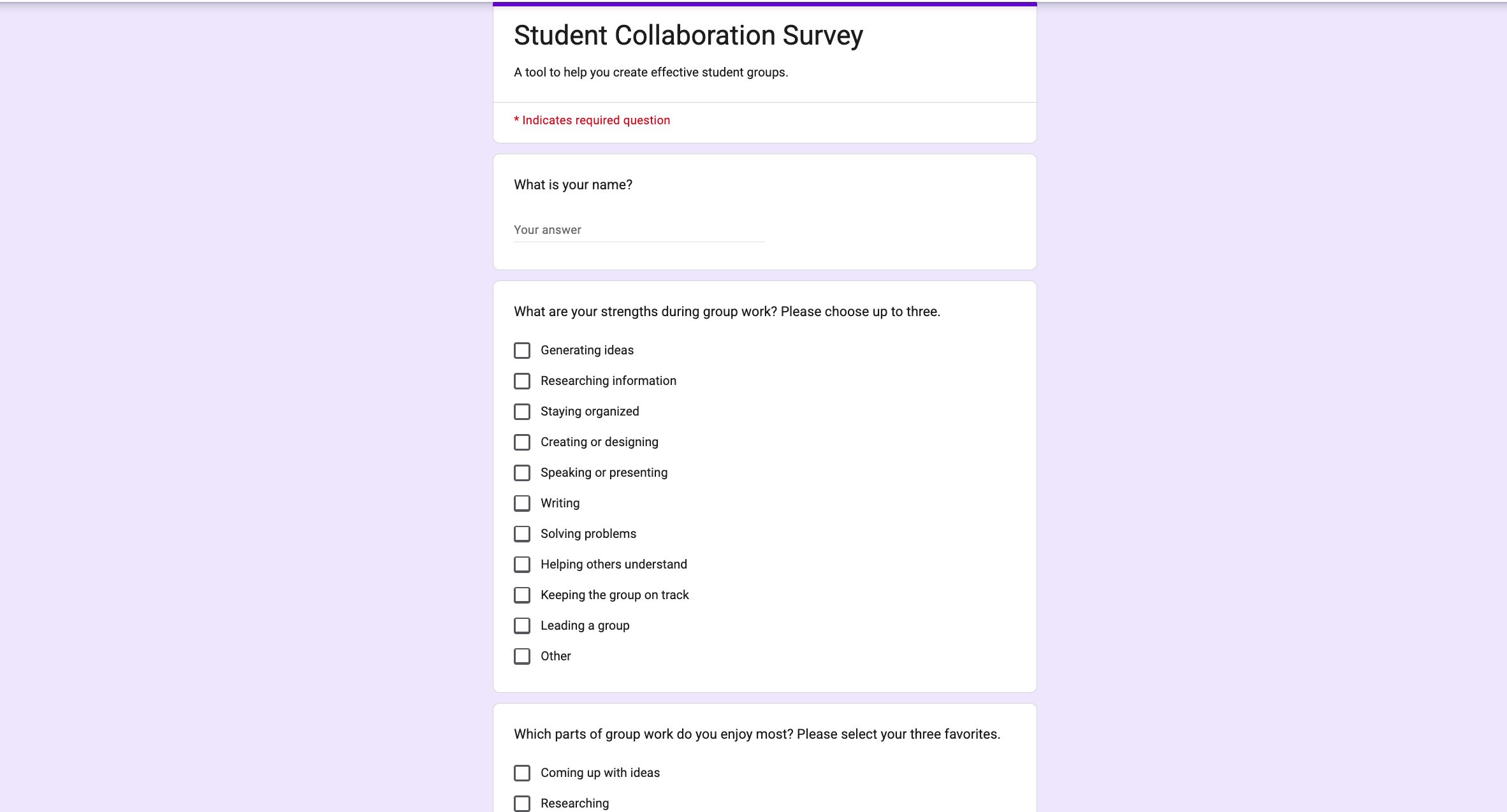
Another way to strategically form groups is to simply ask students what they bring to one. I like using a short Student Collaboration Survey where students identify their strengths, such as generating ideas, researching, staying organized, creating, presenting, writing, or problem-solving. They can also share the role they typically enjoy in a group, topics they’re interested in, and an area of collaboration they’d like to improve. This gives you information that grades and assessment data simply can’t.
You can make the survey even more useful when students already know the specific tasks a project will require. For example, maybe you know each group will need to create a slide deck, give a presentation, design original artwork, and edit a video. Ask students to rank those tasks from the ones they’d most like to do to the ones they’d least prefer. Now you have information you can use to spread different strengths and interests across groups. You can’t guarantee that every student will get their first choice, nor should you, since part of collaboration is learning to take on different roles. But you can give students some voice in the process and increase the likelihood that they’ll get to contribute in ways they enjoy.
And now, AI can make using all of this information much easier. Instead of sorting through 30 surveys yourself, enter the responses into an AI tool and prompt it: “Based on these survey responses, create balanced groups of four that maximize diverse strengths, interests, and participation opportunities. When possible, assign students to groups where they can take on one of their highest-ranked project tasks.” You can then review the suggested groups and make adjustments based on what you know about your students.
Want me to make this easier? Grab my free Student Grouping Survey. It is a customizable Google Form you can use in your classroom.
Know Your Students
Ultimately, the best strategy for forming student groups is also the simplest: know your students.
The End-to-End Strategy, collaboration surveys, and AI can all help you create more balanced groups, especially early in the year. But none of them can replace what you learn from spending time with students. Over time, you begin to know who is a natural leader, who has great ideas but rarely speaks up, who keeps everyone organized, who needs encouragement to participate, and who might need the opportunity to step into a role they don’t normally take on.
You also learn which students bring out the best in each other, which combinations create distractions, and which students might benefit from working with someone completely different from them.
That’s where strategic group formation becomes less about following a formula and more about using your judgment. Sometimes you’ll build a group around complementary strengths. Other times, you might intentionally put a student in a situation that stretches a skill they need to develop. The goal is to create groups where students can be successful while continuing to grow.
The more you know about your students’ strengths, skills, personalities, interests, and needs, the more intentional you can be about putting them together.
Stay Connected With Trevor's Work
Join thousands of educators who receive weekly articles, videos, and inspiration from Trevor.
SPAM is the worst. I promise to only send you my best stuff and NEVER to share your email.
Author