The Problem-Solving Gap in Schools
Mar 26, 2026Right after I graduated college, I got a job with a lawn care company. During the interview, the manager asked if I had experience operating commercial lawn mowers. I had used push mowers and riding mowers to mow my own lawn growing up, so I figured it couldn’t be that different. I said yes with confidence, and he believed me. I got the job and he told me I could start the next morning.
On my first day, the crew leader, Brian told me to take the mowers off the trailer. I walked back expecting something familiar, but instead, found machines three times the size of anything I had ever used, controlled by two levers instead of a steering wheel, with a small trailer you have to stand on that's attached to the back of the mower, making you pivot and swing around as you mow at 15 miles and hour. I had to back these things down a ramp.
And had no idea what I was doing.
I fired it up, pulled the levers back, and the machine jerked violently, spun, slammed into the side, and crashed off the ramp. I went flying and nearly got crushed by the mower. As I was lying on the ground with the dented $15,000 machine still running beside my head, blood running down my scraped up arms, Brian ran over to me.
I expected him to be concerned. Say something like, "Are you okay buddy? That was a nasty fall!"
That's not what he said. Instead he yelled, “What the hell are you doing?! You said you knew how to run this machine!”
Oops. I might have left that part out of the interview.
The Shift to Skills-Based Hiring
I got that job because I said the right thing in an interview. And I lost that job because I in fact did not know what the hell I was doing.
I sounded confident and could repeat the information the interviewer wanted to hear. But the moment I had to actually do the work, it was obvious I wasn’t qualified.
For a long time, hiring has relied on signals like resumes, degrees, and how well someone can describe their experience. Those signals still exist, but they are starting to carry less weight on their own. Right now, 67% of Fortune 500 companies are shifting toward skills-based hiring practices. In many job interviews, instead of just asking a series of questions, candidates are now given real scenarios to work through. Organizations don't just want to see what you can recite, but what you can actually do.
They want to know if you can solve problems.
For instance, at Google, a candidate might be told they are working on Google Maps and that users are reporting restaurant search results feel off. They are given a limited amount of time to think through the situation and explain how they would approach it. That includes identifying possible causes, deciding what data they would look at first, proposing a change to test, and explaining how they would measure whether it worked. The goal is to understand how well the candidate can solve real problems.
A 2024 study from TestGorilla found that 76% of companies using this approach believe it has improved the quality of their hires, and 91% of hiring managers say candidates hired for their skills perform better than those hired based on degrees alone.
This reflects a shift in what employers are trying to measure. Instead of asking whether someone appears qualified, they are trying to determine whether that person can actually perform. Can they solve problems, make decisions, and respond when things don't go according to plan?
What Employers Actually Want and What School Should Focus On
The National Association of Colleges and Employers surveyed thousands of employers about the competencies they prioritize, and the top response was problem solving. And that makes sense when you consider the nature of real work. Most important problems don't come with clear instructions or answer keys. People are making decisions with incomplete information, weighing tradeoffs, testing ideas, and adjusting as they go. The ability to navigate that process has become increasingly valuable.
And AI is accelerating this shift. Tools can now generate answers instantly, summarize information, and produce polished responses. What they cannot do is take responsibility for decisions in complex situations or weigh competing priorities in a meaningful way. As a result, the value is shifting away from producing answers and toward using judgment. The skill is not simply finding information. It is knowing how to interpret it, question it, and apply it.
The Problem-Solving Gap in Schools
This raises an essential question for schools: If problem solving is one of the most valued skills, how often are students actually practicing it inside the classroom?
In many cases students are rewarded for completing assignments, following directions, and recalling information. Those aren't unimportant skills, but they don't fully prepare students for career and life. Students can do well in school without knowing how to solve real problems.
Teaching Problem-Solving
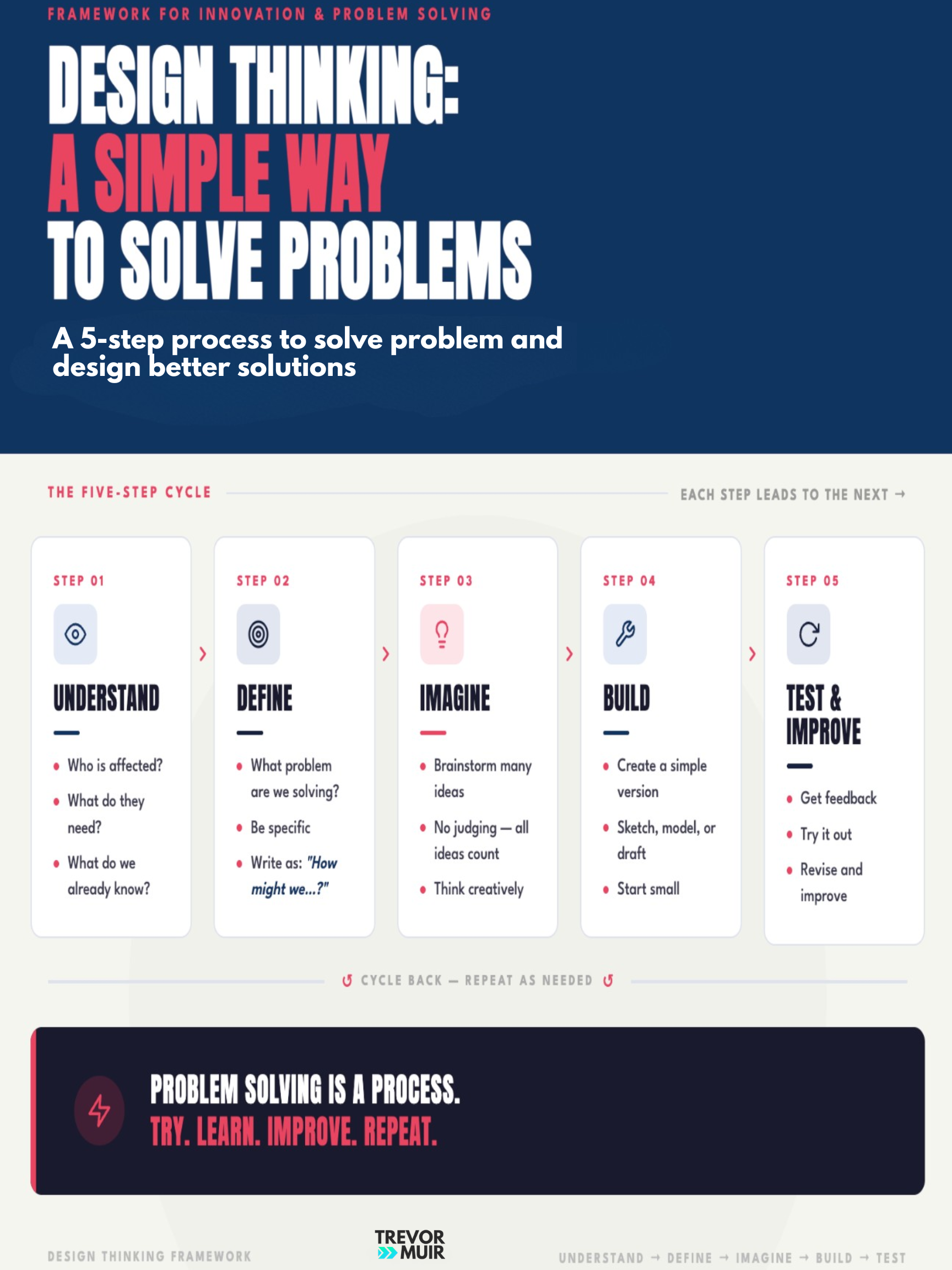
School needs to emphasize teaching problem-solving to students, and one of the best ways to do this is through using the design thinking process. At its core, design thinking involves understanding a problem, defining it clearly, generating possible solutions, testing an idea, and refining based on what is learned. It is not a linear process, but reflects how people actually work through challenges.
So start by explicitly teaching the design thinking process. This begins with modeling it yourself. Verbalize problem solving in front of your students, showing them how you practically work through the process. For example, imagine you’re teaching a class and something isn’t working. Maybe students are disengaged during a particular activity. Instead of just moving on or adjusting quietly, you could bring students into your thinking.
You might say, “I’ve noticed that during this part of class, a lot of us are losing focus. I’m trying to figure out why that’s happening. Here are a couple possibilities I’m considering.” Then you walk them through your reasoning. You name the problem, consider options, and explain how you’d test a solution.
You're making your thinking visible. It sounds simple, but that's because it is. Students need to see what it looks like to work your way through a problem. Hang a poster of the design thinking process (or whatever problem-solving method you like best) permanently on your classroom wall. Reference it every time students solve a problem. Remember, problem-solving isn't intuitive. This skill needs practice and repetition, and the more they can practice it and use an effective protocol, the more they will develop the skill.
Get a FREE printable Design Thinking Poster here.
You Don’t Need to Rewrite Your Curriculum
Students need opportunities to apply this thinking within the content they are already learning. The goal is not to introduce random or disconnected problems, but to surface the real problems that already exist within the curriculum. Teaching problem-solving doesn't require a complete overhaul of curriculum. The content teachers are already responsible for can serve as the foundation for meaningful problem solving.
In a high school math class, this could look like asking students to design a parking lot for the school, using formulas to determine space or budget.
In an elementary science class, it might involve investigating how to improve a local environment rather than simply learning about them. In both cases, the content remains central, but the purpose of learning changes. It really is just an application of learning. And this actually makes it stick. Research shows that students retain significantly more when they apply what they are learning compared to when they engage passively.
A Simple Framework to Start

Stay Connected With Trevor's Work
Join thousands of educators who receive weekly articles, videos, and inspiration from Trevor.
SPAM is the worst. I promise to only send you my best stuff and NEVER to share your email.
Author